
'The ability to tailor schemes to market conditions and invest in unlisted equity and real estate, as well as commodities, makes Alternative Investment Funds a sought after platform.'

Social media giant Meta Platforms and Bharti Airtel on Monday announced a collaboration to jointly invest in telecom infrastructure to cater to the rising demand of high speed data and digital services in India. The announcement comes on the back of telecom operators' demand to share revenue with service providers to build networks. "Airtel and Meta will jointly invest in global connectivity infrastructure and CPaaS (communications platform as a service) based new-age digital solutions to support the emerging requirements of customers and enterprises in India," the statement said.

The share of non-resident Indians (NRIs) and overseas investors in Indian mutual funds has been declining over time, despite adding half-a-trillion rupees to holdings over the last five years. Mutual fund holdings for the segment went up from Rs 0.95 trillion as of December 2018 to Rs 1.54 trillion as of December 2022, shows Business Standard analysis of data from the industry body Association of Mutual Funds in India (Amfi). Their share in overall mutual fund assets has fallen from 4.2 per cent to 3.9 per cent during the same period.

Exposure to debt funds and gold is essential even if current returns from these asset classes are low, suggests Sanjay Kumar Singh.

The investor has now put together a fund of $3.75 billion to back private companies.

'This is the first time we will see how SIP investors react to market correction.'

Despite gold prices hitting record highs, analysts aren't gung-ho about the outlook for gold financiers Muthoot Finance and Manappuram Finance. This, they said, was due to intense competition from banks, coupled with stagnating loan books and likely pressure on margins.

When there is panic, you get an opportunity to get your hands on some of the good stocks.

Catamaran, the family office of Infosys founder Narayana Murthy, is targeting 15 per cent returns on its portfolio investments per annum as it shifts focus from early-stage investments to growth and late-stage bets. This would double the firm's assets under management (AUM) from the current $1 billion to $2 billion over the next five years. "For direct investments, we are focusing on growth-stage investments and very selectively on early stage," Deepak Padaki, president, Catamaran, told Business Standard. "(This is) primarily because the early-stage space in India, in the last three-four years, has completely changed. "There has been a huge influx of capital in the last two years. It has become a very crowded space for early-stage investment," he said.

After a technology upgrade, the Multi Commodity Exchange of India (MCX) appears poised for an improvement in volumes. The premier commodity and forex exchange reported a loss of Rs 19.1 crore in the July-September quarter (second quarter, or Q2) of 2023-24 (FY24). This was attributed to higher software charges payable under an extended service agreement with 63 moons technologies and a one-off cost towards core guaranteed funds (CGF).

10 high dividend paying stocks across sectors that are expected to maintain or even increase their pay-outs in FY23 thanks to faster earnings growth in the last four quarters.

rediffGURU and financial planning expert Colonel Sanjeev Govila (retd) answers your personal finance-related questions.

Do you have parents who have turned 60? You may want to forward Sarbajeet K Sen's suggestions to them.

Ajit Mishra, vice president, research, Religare Broking, answers your stockmarket queries.

'This resilience should be viewed as reflecting the strength of the structural story.'

Smaller stocks have emerged as Dalal Street's favourites in 2023 that has turned out to be a "great year" for equities, rewarding investors with big gains, driven by optimism over the country's macroeconomic fundamentals and heavy retail investors participation. Experts said equity markets are experiencing a prolonged bull run and it is during this time that the midcap and smallcap segments tend to outshine their larger counterparts. Till December 22 this year, the BSE smallcap gauge has jumped 13,074.96 points or 45.20 per cent while the midcap index has surged 10,568.18 points or 41.74 per cent.

The benchmark Nifty50 managed to reclaim its 200-day moving average (DMA) on Wednesday but about half of top 500 stocks continue to languish below this key technical indicator. The 200-DMA - nearly a year's average of closing prices - is analysed by traders to understand the market sentiment. A fall below these levels indicates a weak trend.
Friday will be a landmark day for domestic markets, with all the listed stocks entering the professed T+1 (trading plus one day) settlement cycle. About 200 stocks, which account for more than 80 per cent of India's market capitalisation, will be settled on a next-day basis, with effect from January 27. This will evidently complete the transition to the T+1 cycle that started in February 2022 with the bottom 500 stocks in terms of market value.

Telecom operator Bharti Airtel on Tuesday posted a 49.2 per cent jump in its consolidated net profit to Rs 3,005.6 crore for the January-March quarter of 2022-23 on the back of new 4G customers and strong growth in average revenue per user (ARPU). The company had recorded a net profit of Rs 2,007.8 crore in the same period a year ago. Bharti Airtel's consolidated revenue from operations grew by 14.31 per cent to Rs 36,009 crore during the reported quarter from Rs 31,500.3 crore in the March 2022 quarter.

Meta Platforms Inc, the parent company of WhatsApp, will partner with Reliance JioMart for a service where WhatsApp users can buy groceries on the messaging platform from the Indian retail firm. Mark Zuckerberg, chief executive officer (CEO) of Meta Platforms, said in a Facebook post, "[I am] Excited to launch our partnership with JioMart in India. "This is our first-ever end-to-end shopping experience on WhatsApp--people can now buy groceries from JioMart right in a chat." "Business messaging is an area with real momentum and chat-based experiences like this will be the go-to way people and businesses communicate in the years to come," he said in an announcement coinciding with the annual general Meeting (AGM) of Reliance Industries the parent company of JioMart.

Nikunj Saraf, Vice President Choice Wealth, answers your queries.

A young couple sharing a laugh - in the living room over a Polish joke book, on the beach, in the rain - with the tagline, "Made for each other", hung from billboards at prominent street corners from the 1960s to the 1990s. It was a campaign for one of the largest selling cigarette brands in India, Wills (Navy Cut) from the ITC stable, that resonated with a generation of smokers and non-smokers alike till the curtains came down on tobacco advertising in 2004. As we prepare to welcome 2024, ITC has metamorphosed from a tobacco giant into a conglomerate straddling multiple large-sized businesses. In the mind space of Gen Z or millennials, the company represents a gamut of branded products - from frozen food (ITC Master Chef), noodles (YiPPee!), and cookies (Sunfeast) to snacks (Bingo!) and notebooks (Classmate), and so on and so forth.

Over longer periods of three, five and 10 years, small-cap funds have rewarded their investors handsomely.

An NCD's credit rating will tell you whether risk possibility is high or low. Instruments rated below AA are regarded as high-risk.

In the face of tax blow, brokerages remain sanguine about the prospects of asset management companies (AMCs). A sharp correction in the shares of AMCs over the past three months factors in most of the negatives and turned valuations attractive, observe analysts. In its latest report, Kotak Institutional Equities (KIE) has upgraded HDFC AMC to 'add' (from 'reduce') and reprised 'add' and 'buy' ratings on the rest of the listed AMCs - Nippon, UTI, and Aditya Birla Sun Life.

'Our Q1 was almost flat, and there was very negligible growth in Q2, but the deal pipeline and the order book have been fairly significant.'

As part of its road map to achieve 100 per cent dependence on renewable energy by 2025, Amazon on Wednesday announced its first utility-scale renewable energy projects in India - three solar farms located in Rajasthan. These include a 210-megawatt (Mw) project to be developed by India-based developer ReNew Power, a 100 Mw project to be developed by local developer Amp Energy India, and a 110 Mw project to be developed by Brookfield Renewable Partners. By the end of 2021, the company had reached 85 per cent renewable energy across its business.
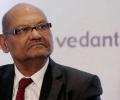
Mining magnate Anil Agarwal's conglomerate on Friday announced a major business shake-up, with flagship Vedanta Ltd approving a spin-off of its metals, power, aluminium and oil and gas businesses into separate listed entities and an overhaul of lucrative zinc unit planned as part of value creation and reducing debt load. Vedanta will issue one share of the five demerged businesses for every share held in the company, the firm said in a statement. The entire exercise, which would require shareholder and lender approval as well as a nod from the stock exchanges and courts, is expected to be completed in 12-15 months, its president for finance Ajay Agarwal said.

As and when the GST comes in, Budget projections will have to be unbundled and revised. In fact, the pragmatic decision would be to present another Budget! This makes the passage of the Finance Bill with its multiple unrelated amendments seem even more dubious, says Devangshu Datta.

'For those looking at forward-looking signals for the economy from the stock markets, the relative performance of small and mid-caps may be a better indicator of the future than the index levels of the narrower and more popular indices', says Neelkanth Mishra.
This may mean easier access, simplified KYC and documentation requirements, and fewer investment restrictions for a majority of FPIs, especially broad-based funds and pooled vehicles that were earlier part of Category-II.

Outsourcing needs trained professionals who can think like American mangers and correspond with customers. It takes years to develop these skills, says SlashSupport CEO Shiva Ramani.

Regulator Irdai on Friday directed SBI Life Insurance Company to takeover the policy liabilities of around two lakh policies along with assets of Sahara India Life Insurance Co Ltd (SILIC) with immediate effect. The decision was taken at the meeting of the Insurance Regulatory and Development Authority of India (Irdai) in view of deteriorating financial health of the SILIC. "The Authority has identified SBI Life Insurance Company Limited (SBI Life), which is one of the largest life insurers in the country with satisfactory financials, as the acquirer insurer of the life insurance business of SlLIC.

Reserve Bank Governor Shaktikanta Das on Wednesday said in the wake of appreciating US dollar, the movement of rupee has remained least disruptive as compared to its peers, and the size of foreign exchange reserve is comfortable. On a financial year basis (from April to October 2022), the rupee has appreciated by 3.2 per cent in real terms, even as several major currencies have depreciated, he said while announcing the latest set of bi-monthly monetary policy. "The story of the rupee has been one of India's resilience and stability," the Governor said while pointing out that the appreciation of the US dollar this year, which precipitated large-scale depreciation of all major global currencies including the Indian rupee, has drawn wide attention.

Companies don't have to be in the field to nudge people to return money they owe lenders.

With equity and commodity exchanges allowed to enter each other's areas from October, brokerages are pump-priming their businesses to allow their clients seamless trading in commodities and equities.

Infosys has been making bets on automation and other high-margin services like artificial intelligence to regain some ground

After withdrawing record funds in 2021-22, foreign portfolio investors (FPIs) continued their sell-off in the last fiscal too and pulled out Rs 37,631 crore from Indian equities amid aggressive rate hikes by central banks globally. The outflow trend is likely to reverse in the current financial year since India has the best growth potential in the financial year 2023-24 (FY24), VK Vijayakumar, chief investment strategist at Geojit Financial Services, said. Market analysts believe that FPI flows in the current financial year would be decided by a host of factors, such as the US Federal Reserve's policy stance, oil prices movement and development in the geopolitical situation.

Having exposure to international funds and gold is a must for those who have foreign currency-denominated goals.

Despite the current bout of volatility, debt-oriented hybrid funds remain well suited for risk-averse investors.
